
Thursday, February 8, 2018

INK by Battistella in downtown Calgary

INK by Battistella is a 14 storey condo development in downtown Calgary. Ture to Battistella style, the building features bold colours and articulating balconies, which separates it architecturally from other buildings. Interiors are inspired by industrial warehouse lofts, with polished concrete floors and concrete ceilings with exposed ducts and wires.  A place where creatives and urban explorers converge in celebration of smaller, smarter homes and life with less baggage and more room to breathe. 119 comfortable and efficient city homes combine with a convenient collection of amenities including a roof-top patio with all-season glass lounge, secure bike storage, dog wash station and shared tool library. INK by Battistella is downtown living at its most affordable and accessible.


Drone views

Purchase contract

Floor plans

Neighborhood

The post INK by Battistella in downtown Calgary appeared first on Vancouver New Condos.


from Buildings – Vancouver New Condos http://ift.tt/2Ew6Olu

Monday, February 5, 2018

University Heights by Holborn in Squamish

Situated on one of the highest elevations in Squamish, UNIVERSITY HEIGHTS by Holborn offers panoramic mountain views next to Quest University within the Garibaldi Highlands community. Centrally located within a 5 minutes’ drive to downtown Squamish, UNIVERSITY HEIGHTS by Holborn offers exclusive private community living whilst remaining easily accessible to your everyday needs.

With spectacular view lots ranging from 6,784 to 17,300 square feet, UNIVERSITY HEIGHTS by Holborn ensures your new home will be everything you want it to be.

Phase 2 Lots 94-111 NOW SELLING!

The post University Heights by Holborn in Squamish appeared first on Vancouver New Condos.


from Buildings – Vancouver New Condos http://ift.tt/2BXbKKJ

University Heights by Holborn in Squamish

Situated on one of the highest elevations in Squamish, UNIVERSITY HEIGHTS by Holborn offers panoramic mountain views next to Quest University within the Garibaldi Highlands community. Centrally located within a 5 minutes' drive to downtown Squamish, UNIVERSITY HEIGHTS by Holborn offers exclusive private community living whilst remaining easily accessible to your everyday needs.

With spectacular view lots ranging from 6,784 to 17,300 square feet, UNIVERSITY HEIGHTS by Holborn ensures your new home will be everything you want it to be.

Phase 2 Lots 94-111 NOW SELLING!

The post University Heights by Holborn in Squamish appeared first on Vancouver New Condos.


from Buildings – Vancouver New Condos http://ift.tt/2BXbKKJ

Surprise, Carrots Don’t Actually Improve Eyesight

Surprise, Carrots Don't Actually Improve Eyesight

As children, we're often told little white lies or half-truths in order to be coerced or persuaded into doing something we resist. I didn't think this was fair game until I became a parent myself, and find myself making promises to my toddler that, at her age, she easily forgets. (I'm sure this will come back to bite me in the butt in a couple of years.)

So it makes me smile when I remember the oft-repeated "motivations" (read: manipulations) by my parents to encourage me to eat more vegetables: carrots will give me crystal clear vision or — my personal favorite as a kid — spinach will make me stronger (like Popeye!). While I eventually figured out that spinach won't give me superhuman strength, I'd always accepted — even as an adult — that carrots were good for the eyes and we needed to eat a lot of it. I think my ophthalmologist even told me so at one point.

You can imagine my reaction when I learned in later years that the carrot's claim to fame is nothing more than an urban myth, born from propaganda spread during World War II.

Surprised? So was I.

During the war, the British Royal Air Force (RAF) developed a type of radar technology that aided pilots in gunning down German enemy planes at night. The onboard Airborne Interception (AI) radar, first used by the RAF in 1939, had the ability to detect enemy bombers before they reached the English Channel.

Ace fighter pilot John "Cat's Eyes" Cunningham was the first RAF pilot to shoot down an enemy plane in 1940 using AI. His impressive record boasted 20 kills — 19 of which were at night.

In order to keep the newly adopted technology under cover, the now-defunct Ministry of Food attributed the British pilot's success to carrots. They told newspapers that the pilot's razor-sharp night vision was a result of consuming a steady diet of carrots, and claimed that civilians could also have eyesight as good as Cunningham's (especially during mandatory citywide blackouts) if only they ate more carrots and stopped complaining about wartime rations.
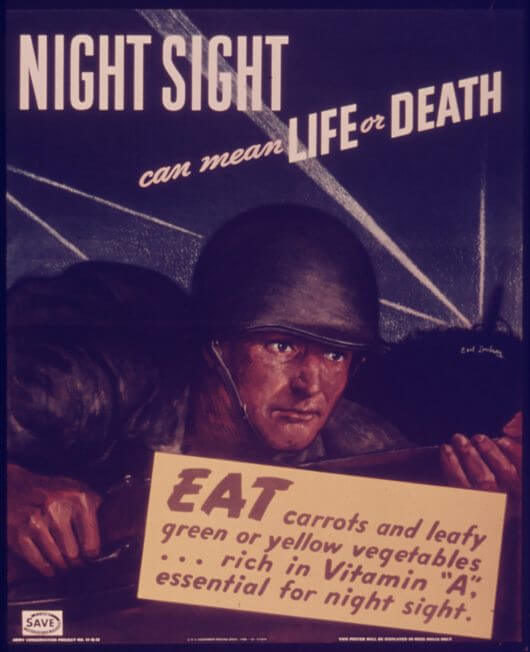
World War II British propaganda claimed carrots improve eyesight

Image by US National Archives and Records Administration.

On the surface, this seemed plausible. The humble root vegetable was known as a good source of vitamin A (in the form of beta carotene), a vital nutrient for general health of the eyes as well as the skin, hair, and immune system.

But that is where the rumor runs into a gray area.
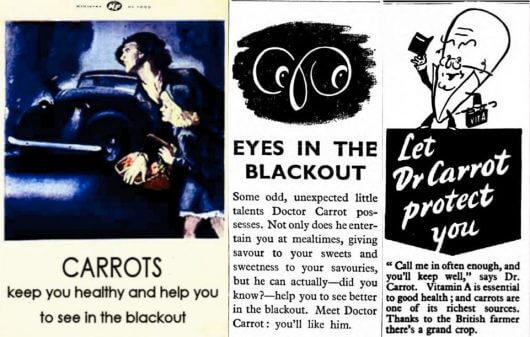
Propaganda posters that claim carrots can help night vision

Images by US National Archives and Records Administration.

While it's true that vitamin A deficiency can lead to vision impairment (even blindness in severe cases), binging on carrots won't improve eyesight if you already have enough beta carotene in your body. After a certain level, it will no longer convert to vitamin A, since the body naturally regulates against excess amounts to prevent a toxic build-up of the substance.

What constitutes "enough" or "excess" is also uncertain in the scientific world. Most studies focus on the benefits of beta carotene or vitamin A supplements, rather than actual carrots. And you can't treat or reverse eye problems caused by aging or genetics simply by eating more carrots.

Furthermore, carrots get all the hype, but vitamin A is also found in other vegetables like sweet potatoes, winter squash, mustard greens, and spinach.

Historical sources are mixed on whether or not the British propaganda campaign succeeded in "tricking" the Germans into upping their carrot consumption. What's clear, however, is that the British public bought into it. They believed that carrots could help them see better during blackouts. They ate so much of it that they helped ease the wartime oversupply of carrots.

The carrot propaganda was so popular, in fact, that when a German blockade of food supply ships made imported staples such as sugar, bacon, and butter scarce, the British Ministry of Food called on its citizens to change the way they eat. They launched the "Dig For Victory" campaign (a version of which was promoted by the United States government as well) to push for self-sufficiency in the garden and encourage people to try new techniques, like substituting carrots as a sweetener in recipes that typically used sugar.

World War II victory garden posters

Images by US National Archives and Records Administration.

From carrot fudge to carrotade, the Ministry of Food offered an array of crazy ideas for using up the vegetable but above all, they emphasized avoiding waste. By 1942, there were so many carrots produced that the UK had 100,000 tons surplus of the vegetable!
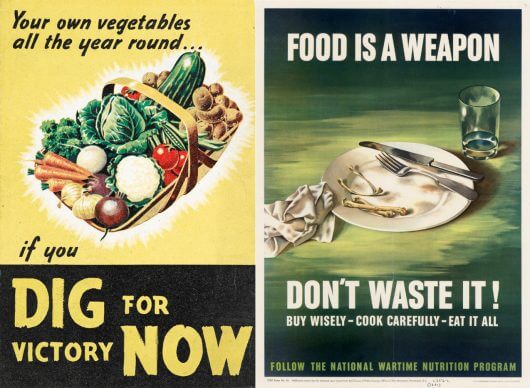
British wartime propaganda inspired the victory garden movement

Images by US National Archives and Records Administration.

In the end, carrots did not contribute to improved night vision in the way many believed. But it helped win the war on a different front: by inspiring people to grow their own food, try new recipes, and waste as little as possible.

(Shameless plug: My first book, The CSA Cookbook, offers over 100 no-waste recipes for vegetables and all the parts you normally don't think to eat and cook with! And yes, that includes carrots and carrot tops.)

The post Surprise, Carrots Don't Actually Improve Eyesight appeared first on Garden Betty.

Spring is coming! And to help you figure out what to do with all those weird vegetables and parts you thought you couldn't eat, The CSA Cookbook makes an excellent addition to your cooking or gardening library.


from Garden Betty http://ift.tt/2EIH4js

Surprise, Carrots Don’t Actually Improve Eyesight

Surprise, Carrots Don’t Actually Improve Eyesight

As children, we’re often told little white lies or half-truths in order to be coerced or persuaded into doing something we resist. I didn’t think this was fair game until I became a parent myself, and find myself making promises to my toddler that, at her age, she easily forgets. (I’m sure this will come back to bite me in the butt in a couple of years.)

So it makes me smile when I remember the oft-repeated “motivations” (read: manipulations) by my parents to encourage me to eat more vegetables: carrots will give me crystal clear vision or — my personal favorite as a kid — spinach will make me stronger (like Popeye!). While I eventually figured out that spinach won’t give me superhuman strength, I’d always accepted — even as an adult — that carrots were good for the eyes and we needed to eat a lot of it. I think my ophthalmologist even told me so at one point.

You can imagine my reaction when I learned in later years that the carrot’s claim to fame is nothing more than an urban myth, born from propaganda spread during World War II.

Surprised? So was I.

During the war, the British Royal Air Force (RAF) developed a type of radar technology that aided pilots in gunning down German enemy planes at night. The onboard Airborne Interception (AI) radar, first used by the RAF in 1939, had the ability to detect enemy bombers before they reached the English Channel.

Ace fighter pilot John “Cat’s Eyes” Cunningham was the first RAF pilot to shoot down an enemy plane in 1940 using AI. His impressive record boasted 20 kills — 19 of which were at night.

In order to keep the newly adopted technology under cover, the now-defunct Ministry of Food attributed the British pilot’s success to carrots. They told newspapers that the pilot’s razor-sharp night vision was a result of consuming a steady diet of carrots, and claimed that civilians could also have eyesight as good as Cunningham’s (especially during mandatory citywide blackouts) if only they ate more carrots and stopped complaining about wartime rations.

World War II British propaganda claimed carrots improve eyesight

Image by US National Archives and Records Administration.

On the surface, this seemed plausible. The humble root vegetable was known as a good source of vitamin A (in the form of beta carotene), a vital nutrient for general health of the eyes as well as the skin, hair, and immune system.

But that is where the rumor runs into a gray area.

Propaganda posters that claim carrots can help night vision

Images by US National Archives and Records Administration.

While it’s true that vitamin A deficiency can lead to vision impairment (even blindness in severe cases), binging on carrots won’t improve eyesight if you already have enough beta carotene in your body. After a certain level, it will no longer convert to vitamin A, since the body naturally regulates against excess amounts to prevent a toxic build-up of the substance.

What constitutes “enough” or “excess” is also uncertain in the scientific world. Most studies focus on the benefits of beta carotene or vitamin A supplements, rather than actual carrots. And you can’t treat or reverse eye problems caused by aging or genetics simply by eating more carrots.

Furthermore, carrots get all the hype, but vitamin A is also found in other vegetables like sweet potatoes, winter squash, mustard greens, and spinach.

Historical sources are mixed on whether or not the British propaganda campaign succeeded in “tricking” the Germans into upping their carrot consumption. What’s clear, however, is that the British public bought into it. They believed that carrots could help them see better during blackouts. They ate so much of it that they helped ease the wartime oversupply of carrots.

The carrot propaganda was so popular, in fact, that when a German blockade of food supply ships made imported staples such as sugar, bacon, and butter scarce, the British Ministry of Food called on its citizens to change the way they eat. They launched the “Dig For Victory” campaign (a version of which was promoted by the United States government as well) to push for self-sufficiency in the garden and encourage people to try new techniques, like substituting carrots as a sweetener in recipes that typically used sugar.

World War II victory garden posters

Images by US National Archives and Records Administration.

From carrot fudge to carrotade, the Ministry of Food offered an array of crazy ideas for using up the vegetable but above all, they emphasized avoiding waste. By 1942, there were so many carrots produced that the UK had 100,000 tons surplus of the vegetable!

British wartime propaganda inspired the victory garden movement

Images by US National Archives and Records Administration.

In the end, carrots did not contribute to improved night vision in the way many believed. But it helped win the war on a different front: by inspiring people to grow their own food, try new recipes, and waste as little as possible.

(Shameless plug: My first book, The CSA Cookbook, offers over 100 no-waste recipes for vegetables and all the parts you normally don’t think to eat and cook with! And yes, that includes carrots and carrot tops.)

The post Surprise, Carrots Don’t Actually Improve Eyesight appeared first on Garden Betty.

Spring is coming! And to help you figure out what to do with all those weird vegetables and parts you thought you couldn't eat, The CSA Cookbook makes an excellent addition to your cooking or gardening library.


from Garden Betty http://ift.tt/2EIH4js

Friday, February 2, 2018

Regan West by Marcon

Marcon is excited to announce Regan West, our next Coquitlam project, will be coming to market this Spring.Located steps from the Burquitlam Skytrain Station makes it an easy commute to downtown Vancouver, colleges and universities, entertainment, recreation and shopping throughout the lower mainland. This 6-storey contemporary building will feature 1, 2 and 3 bedroom homes with livable floor plans, a common rooftop patio, and timeless interior design. At Regan West, you are just a short stroll from parks, shopping, and new community amenities.

The post Regan West by Marcon appeared first on Vancouver New Condos.


from Buildings – Vancouver New Condos http://ift.tt/2E9VuuV

Regan West by Marcon

Marcon is excited to announce Regan West, our next Coquitlam project, will be coming to market this Spring.Located steps from the Burquitlam Skytrain Station makes it an easy commute to downtown Vancouver, colleges and universities, entertainment, recreation and shopping throughout the lower mainland. This 6-storey contemporary building will feature 1, 2 and 3 bedroom homes with livable floor plans, a common rooftop patio, and timeless interior design. At Regan West, you are just a short stroll from parks, shopping, and new community amenities.

The post Regan West by Marcon appeared first on Vancouver New Condos.


from Buildings – Vancouver New Condos http://ift.tt/2E9VuuV